Ops Insights #083 - Respond Like a Leader: Recurring Donors Report
February 10, 2026 | Read Time: 4 minutes | Written by Jenny Kleintop
When you want to be invited to the leadership table, you don’t want to respond like most with a data request. You want to respond like a leader, meaning think a step or two ahead. Figure out what they are trying to solve for, enhance, build, or grow, and look to answer that question.
For example, let’s talk through a data request for monthly donors.
Here was the request: We are interested in building out our monthly giving program over the next year. Would you mind sharing a report with me that includes any of the following information that is available:
Monthly donor name
Monthly donor contact info
Monthly donor amount
How long a monthly donor has been giving
Any notes on how/why the monthly donor subscribed...website, email, family connection, etc.
Anything you think is important that I am not asking for.
How most will respond: Provide a list of recurring donors that includes the donor’s name, contact info, amount, frequency of giving, start date, and campaign/appeal of the gift.
How I responded: In addition to providing the list of recurring donors like above, I also provided an analysis. The key message I saw in the request was “We are interested in building our monthly giving program.” That told me a list of donors would not answer their question. They also needed the data analyzed.
The following is what I included with the list of donors.
Year by Year View (New Recurring Donors)
This graph shows us how many “new” recurring givers we get each year.
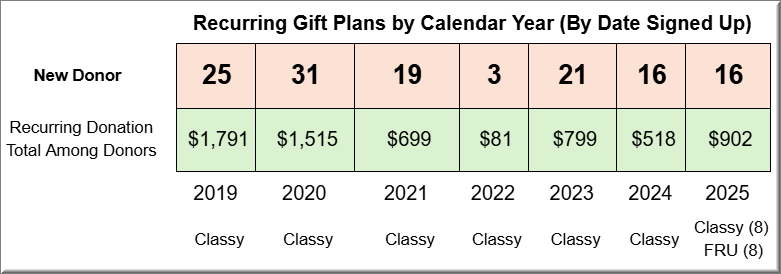
3 additional “monthly” donors who are not tagged as Recurring Givers (see last section below)
Year by Year View (By Using Successful Transactions)
This graph shows us how many recurring givers we have each year.
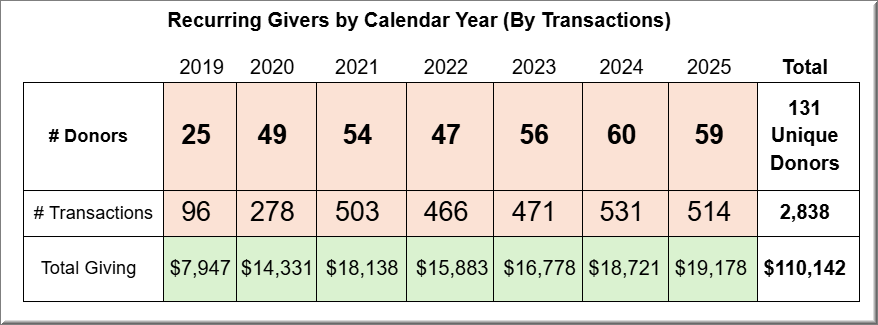
The difference in # Donors in the 2nd graph and # New donors in the top graph would be the # donors that carried on into the next year.
Analysis of Classy Recurring Givers
We migrated 37 active plans from Classy to Fundraise Up
35 are monthly
1 is quarterly
1 is yearly
We had an additional 95 recurring givers in Classy that have ended.
92 were monthly
3 were quarterly
Reason why people cancelled:
10: Can no longer afford it
4: Meant to give a one-time donation
3: Invalid credit card
2: Redirecting the donation to another cause
1: No longer feels connected to the cause
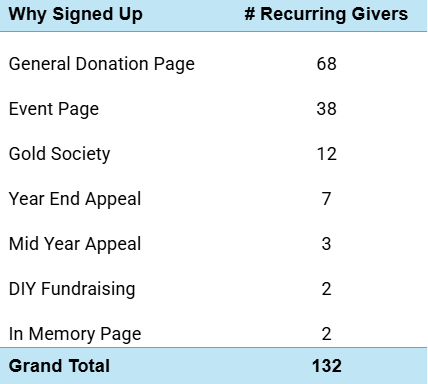
Most are signing up through our general donation forms.
Analysis of Fundraise Up Givers
Since we’ve been in Fundraise Up (since Sept. 2025)
8 new Recurring Givers
7 of these signed up through the Website Donate Button.
1 signed up through the Website DIY Celebration, which is no longer active; it was cancelled per the donor’s request.
We are using a feature in Fundraise Up to encourage donors to give a recurring gift. When they click submit, they will be asked if they want to make it a recurring donation.
Analysis of Monthly Givers Outside of “Recurring Plans”
Looking at donors, any gift type, who have given a gift every month (reviewed gifts last 5 years, 2021 - 2025):
Donor 1 [name redacted]: Via check to greatest need
Gifts every month: 2025, 2024, 2023, 2022, 2021
First gift: 11/19/2001 to an event
Most gifts to the greatest need
Lifetime giving: $10,342 outright and one $175 GIK
Donor 2 [name redacted]: Employee Giving Campaigns
Gifts every month: 2023
First gift:10/19/2008
All gifts coming through an employee giving campaign and going to the greatest need
Last gift: 7/1/2025
Lifetime giving: $4,746
Donor 3 [name redacted]
Gifts every month: 2023, 2022, 2021
As you can see, there are different ways to respond to a data request. Not every data request will need additional analysis. The key is to know your leader, know your team, and, when you can, take the next step to help build, grow, and improve fundraising efforts. Your leader and team rely on you to know the data and help them figure out what they are not asking for that could help, hence that last bullet point in the request that said “Anything you think is important that I am not asking for.” Plus, this is the fun stuff: using the data not only to tell the historical story but also be a part of up leveling future efforts.
If you want to be invited to the leadership table, don’t respond like most. Respond like a leader.
Take Action
When you are asked for monthly giving data in order to improve the program, follow these 3 steps:
1 ➡ Provide the list of donors with donor details.
2 ➡ Perform an analysis of past data to show high-level numbers.
3 ➡ Add narrative/bullet points to explain what the data is saying.
Don’t be like most. Respond like a leader.
You’ve got this!
👋 See you next time,
Jenny
Whenever you're ready, there are two other ways to get help:
Insights: Receive these Insights directly in your inbox to learn, grow, and accelerate your expertise of philanthropy data, database, and operations. Plus, bonus insights are often in the email version. Add your email here.
Hands-On Support: Get personalized assistance when you need it the most through fractional support. View here.